Your lab’s economics live in the gaps between your systems — set long before the instrument runs.
I build the tools built for molecular and genomics labs to find what’s capping profitability and scale — and to model the fix before they commit.
12 years across every layer of the molecular workflow. Vendor-neutral — no referral fees, no implementation revenue.
Sequencing got cheap. The workflow around it didn’t — and that’s where the next gain in the unit economics of genomics lives.

For fifteen years the industry drove down the cost of sequencing — first through chemistry, then through dry-lab automation. The largest gain still on the table isn’t in either: it’s everything that happens before a single read is generated.
I’ve watched the impact of this throughout my career — labs regressing to send-out testing when the unit economics stopped working, technology implementations stalling for months, and in some cases labs closing their doors. The cause usually isn’t the technology itself; it’s an operations problem. E2E sample tracking held together by a spreadsheet, manual data entry between systems, overlapping system boundaries, custom code force-fitting platforms into work they were never designed for, a standing reliance on professional services — all of this drives the cost per test well above what anyone estimated.
Three things drive it:
- Procurement requirements that were never properly scoped — the lab wrote a spec based on the need for one component and didn’t model how that component fits into their E2E workflow, both today and in the future.
- A workflow and total cost of ownership nobody modeled at the process level — high-level estimates leave out the nuance of a fully burdened cost analysis.
- Molecular labs are highly variable and constantly changing — which often results in custom code and shadow systems to fill the gap between system capability and operational needs.
Nobody chose these intentionally. They accumulate quietly — and compound until they choke a lab’s ability to grow and erode its profitability.
I spent 12 years at every layer of the molecular workflow working to support the wet lab, and in the process developed a deep passion for the work labs do. Unusually, I had the opportunity to hold product responsibility for most of it at once — not as a bench scientist or a software engineer, but as the person who had to make the whole system make sense. I’m excited to bring that experience to HelixWrks.
Two ways to close the gap.
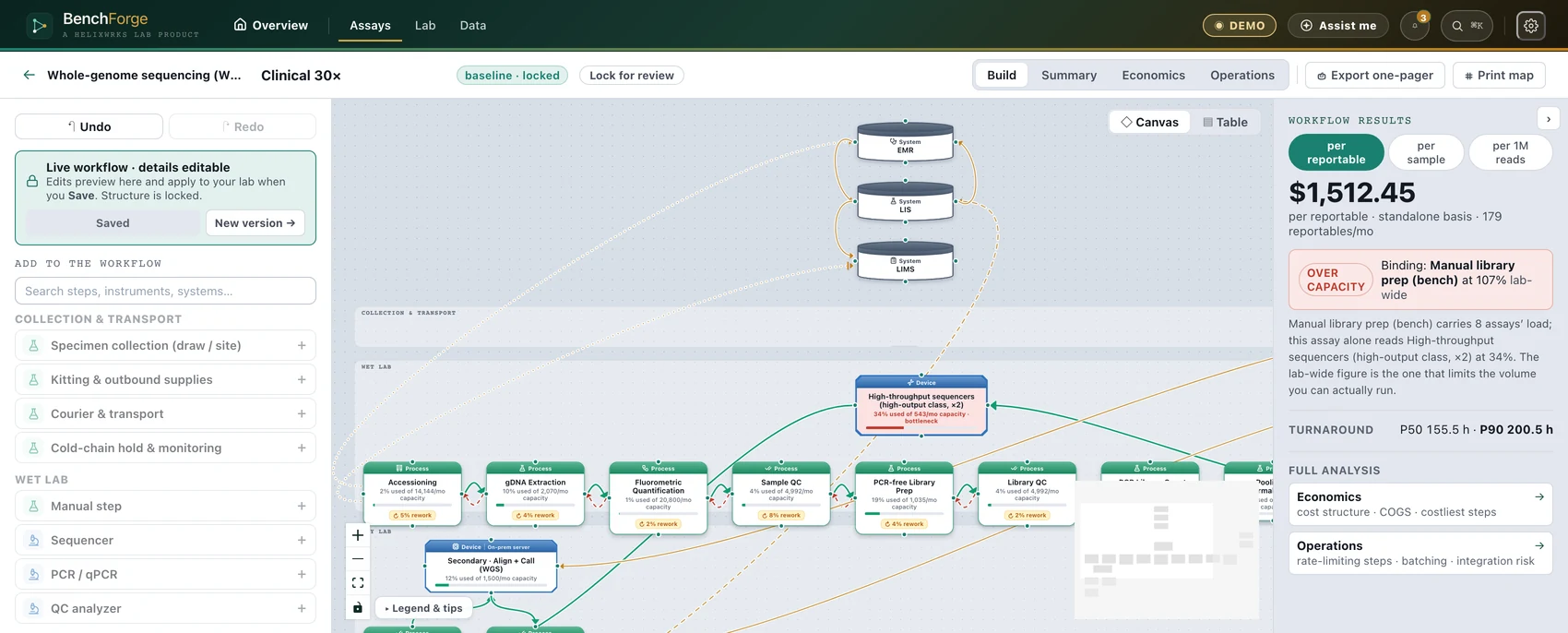
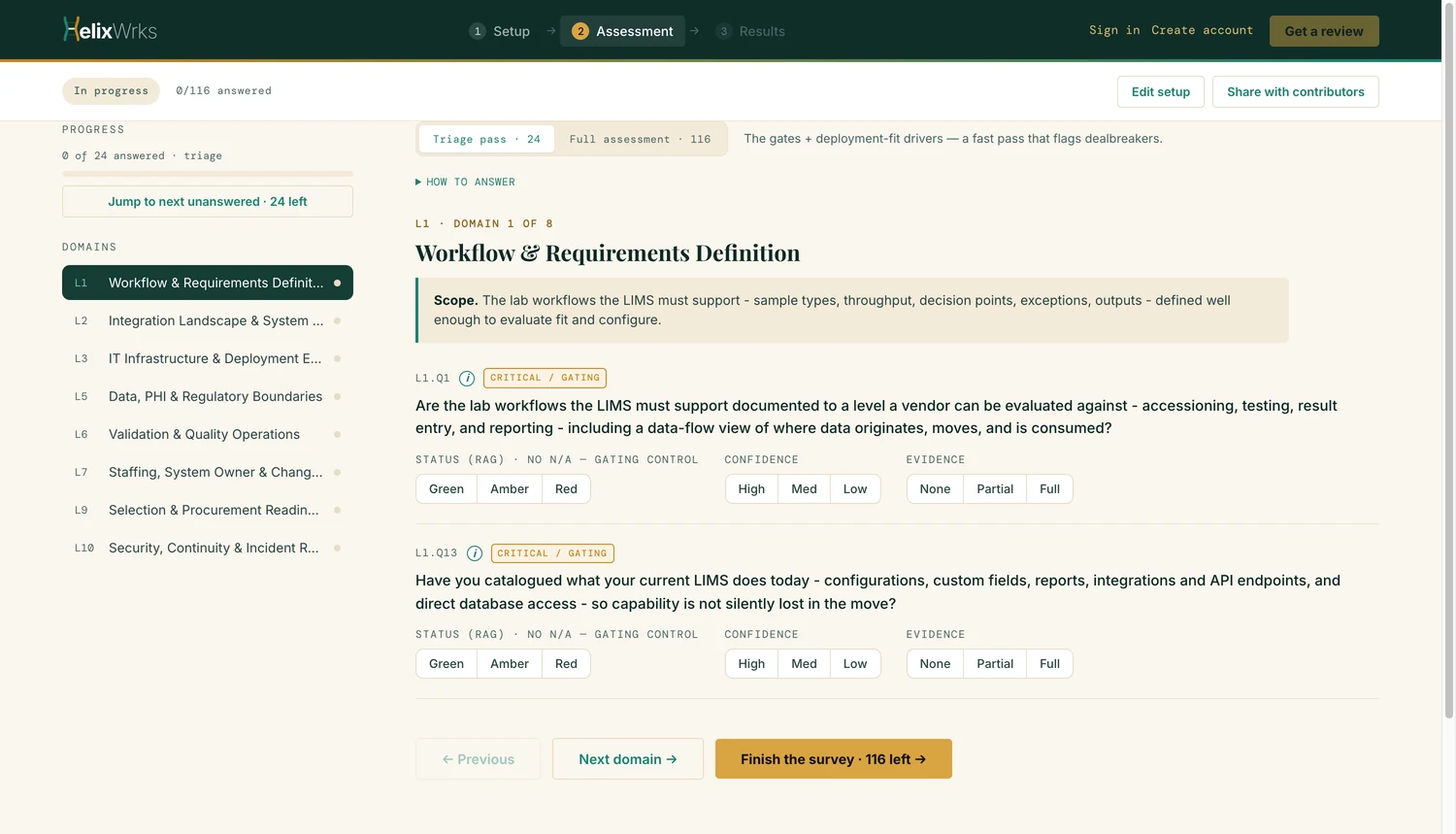
The assessment scores your readiness before you commit. BenchForge models what a change is worth before you spend.
HelixWrks Lab
The same thinking, productized into self-serve tools.
LIMS Readiness Assessment
Scores your implementation readiness across 10 domains — with your whole team, and an Alignment map of where they disagree — before you commit to a vendor.
BenchForge
Maps your whole workflow and models your actual unit economics — every step, not an industry average — then shows which step is limiting you.
Featured thinking
Three featured articles. The full library — including interactive frameworks — lives on the Content & Resources page.
Why LIMS Implementations Fail
Six patterns that play out repeatedly across genomics, molecular diagnostics, and clinical lab environments. The culprit is almost never the technology.
Read →Laboratory Technical Debt
High-throughput platforms sitting well below capacity. Leadership won’t approve expansion. The overhead per sample makes growth uneconomical. How technical debt accumulates — and the path out.
Read →Why End-to-End Workflow Projects Stall — and How to Fix It
How to right-size your E2E architecture for your stage of growth, find your rate-limiting steps before you buy anything, and reframe your lab as a profit center.
Read →